


 +420 267 313 996
 sales@ndtone.com
Holiday Detectors (Pinhole & Porosity Testers)
A holiday detector is a non-destructive instrument that locates discontinuities — holidays, pinholes, pores, cracks and other defects — in protective dielectric coatings. NDT1 Kraft manufactures the Corona series of pulsed high-voltage holiday detectors together with a complete range of electrodes.
Holiday detectors
-
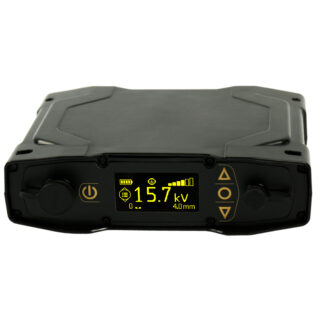
Corona 40 – Holiday Detector
The Corona 40 is a portable high-voltage holiday detector designed for non-destructive inspection of protective dielectric coatings, linings and membranes. It is used to detect coating discontinuities such as pinholes,...
The Corona 40 is a portable pulsed high-voltage holiday detector for detecting pinholes, pores, cracks, leaks and other discontinuities in thick protective dielectric coatings, linings and membranes. It is designed for testing coatings from 0.5 to 25 mm thick.
-
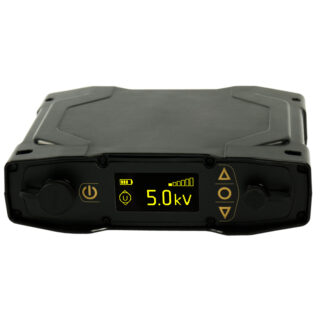
Corona 5 – Holiday Detector
The Corona 5 is a compact portable holiday detector designed for non-destructive testing of thin dielectric coatings on electrically conductive substrates. It detects pinholes, pores, cracks, leaks and other discontinuities...
The Corona 5 is a portable pulsed holiday detector for non-destructive testing of thin protective dielectric coatings. It detects pinholes, pores, cracks, leaks and other coating discontinuities using an adjustable test voltage and is suitable for coatings from 50 µm to 1 mm thick.
-
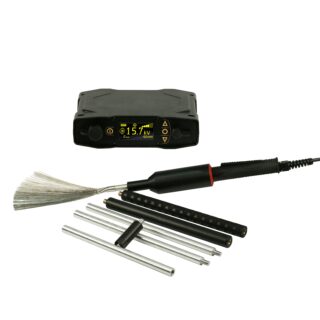
Corona 40 – Flat Roof Leak Detector Kit
The Corona 40 Flat Roof Leak Detector Kit is designed for non-destructive detection of leaks and discontinuities in waterproofing membranes and dielectric roof coatings installed over conductive substrates such as...
The Corona 40 Flat Roof Leak Detector Kit is a portable high-voltage system for detecting pinholes, cracks, leaks and other discontinuities in waterproofing membranes and dielectric roof coatings applied over a conductive substrate or a dedicated conductive layer, such as steel, concrete or aluminium foil.
Electrodes
-

Brush (fan) electrode
The brush (fan) electrode is designed for inspecting flat, cylindrical, and complex-shaped products with dielectric coatings.
Electrode for inspecting protective dielectric coatings of complex profile.
-

Straight silicone rubber electrode
Straight silicone rubber electrode is designed to define places of discontinuities on insulating coatings with low mechanical strength.
Electrode for locating discontinuities in insulating coatings.
-
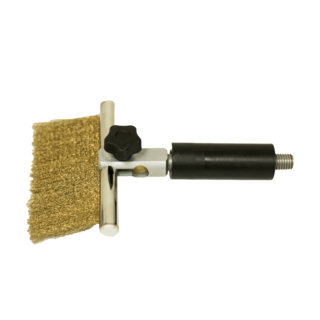
Brush (hair) electrode
Brush (hair) electrode is designed to inspect dielectric coatings with complex profile and larger area. Electrode is used for detecting defects in coatings with low mechanical strength.
Electrode for inspection of dielectric coatings on complex-shaped and large-area surfaces.
-
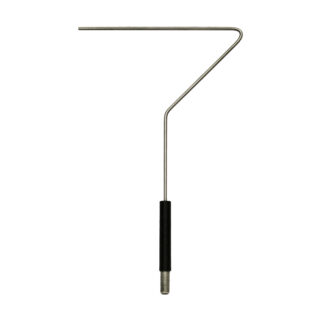
T-shaped electrode
The T-shaped electrode is used for testing dielectric coatings on flat products. When used together with spring electrodes and wide T-shaped tubular electrodes, it enables pinpoint defect localization during inspection.
Electrode is used for testing dielectric coatings on flat products.
-
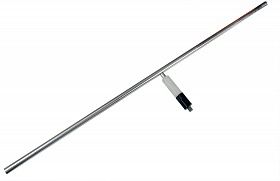
T-shaped tubular electrode (mountable)
T-shaped tubular electrode (mountable) is designed for inspection of flat dielectric coatings, usually large areas like the roofs of buildings. Since it is mountable, the width is adjustable from 200...
Electrode is used for detecting defects in insulating coatings on large-area flat products.
-
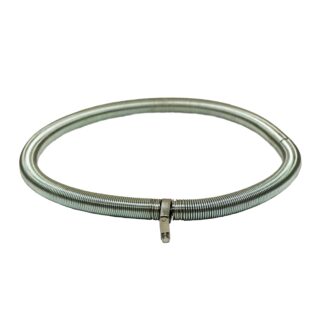
Rolling spring electrodes
Rolling spring electrodes are used for testing insulating coatings on the outside surface of pipes. Available for pipes from 80 to 1620 mm diameter. – Electrode B19 is made of...
Electrodes for detecting defects in external insulating coatings of pipes.
-
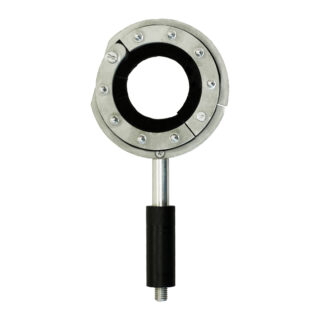
Rubber ring electrode
Rubber ring electrode is used for inspection of the outer surface of pipes diameters from 30 to 426 mm. Optimized design and several standard sizes ensure easy electrode movement and...
Electrode is used for detecting defects in external insulating coatings of pipes.
-
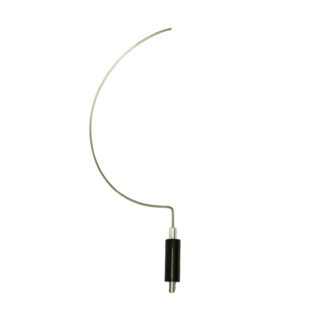
Crescent-shaped electrode
Crescent-shaped electrode is designed to define places of discontinuities on external insulating coatings of the pipes from 25 to 1020 mm diameter.
Electrode for detecting defects in external insulating coatings of pipes
-
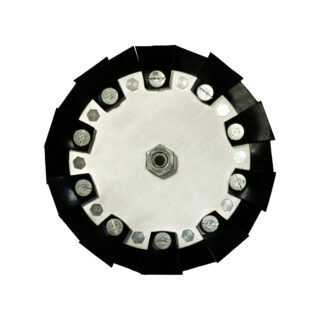
Internal pipe disk electrode
Internal pipe disk electrode is used for inspection insulating coatings inside pipes with the diameter from 30 to 1420 mm.
Electrode for detecting defects in insulating coatings inside pipes.
Holiday testing prevents corrosion by finding areas of thin or missing coating before a structure goes into service. High-voltage spark testing applies a charged electrode across the coating; when the electrode passes over a defect, a spark discharge breaks through to the conductive substrate and the detector triggers an audible and visual alarm. The required test voltage depends on the dielectric strength and the thickness of the coating.
Corona holiday detectors inspect pipeline coatings and linings, storage tanks and vessels, flat-roof and waterproofing membranes, and other dielectric coatings on conductive substrates. A dedicated Corona 40 flat-roof leak-detector kit is available for membrane and waterproofing inspection.
A full set of electrodes — brush (fan and hair), straight silicone-rubber, T-shaped and tubular, rolling spring, rubber-ring, crescent and internal-pipe disc — adapts the detector to flat surfaces, pipe externals and internals, and complex geometries.
Inspection follows recognised standards from NACE/AMPP, ASTM and ISO. Equipment is EU-made and supplied with technical support.
FAQ
What is a "holiday" in a coating?
A holiday is a small area of thin or missing coating — a pinhole, pore, crack or void — that exposes the substrate and can become a corrosion site.
Low-voltage or high-voltage — which detector do I need?
Low-voltage (wet-sponge) testing is used on very thin coatings. High-voltage (spark) testing, like the Corona detectors, covers dielectric coatings and linings across a wide range of thicknesses — for example the Corona 5 is a high-voltage spark detector for thin coatings up to 1 mm (not a wet-sponge tester), while other Corona models suit thicker coatings and linings.
How do I set the test voltage?
The Corona detectors include a built-in voltage calculator: select the standard and enter the coating thickness, and the instrument computes the required test voltage. You can also set the voltage manually. Setting it too high can damage the coating; too low and defects are missed.
Which electrode should I use for pipe internals?
Internal-pipe disc electrodes are designed for inside-pipe inspection. For pipe externals, use rolling-spring and rubber-ring electrodes; tubular electrodes are intended for flat roofs and membranes, and fan (brush) electrodes also suit complex surface geometries.